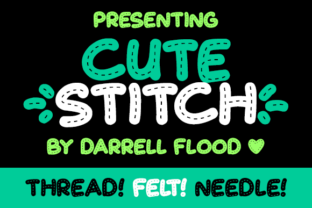
Cute Stitch Font for Handicraft Branding
As a small business owner who handmakes greeting cards, sews custom totes, and sells seasonal craft kits from my home studio, I’ve learned that Cute Stitch isn’t just another decorative font—it’s the warm, fuzzy heartbeat of my brand identity. This Display typeface, designed by Darrell Flood, mimics stitched felt with soft edges, gentle curves, and subtle texture—like something lovingly cut and sewn by hand. It’s not loud or flashy; it’s sincere, approachable, and quietly confident. And because it’s built as a Fonts asset meant for visual impact—not body text—it works exactly where small businesses need standout personality: on product labels, social posts, packaging, and anywhere customers first connect with your story.
Cute Stitch for Handmade Product Labels and Packaging Design
When your lavender-scented soy candles sit beside five other brands at a local market, Cute Stitch helps yours feel handmade *before* someone even reads the scent name. Its stitched-felt texture reinforces authenticity—no stock photo or generic sans serif can do that. I use Cute Stitch for the product name (“Lavender Meadow”) on my candle jars, paired with a clean, readable sans serif (like Montserrat or Inter) for ingredients and burn instructions. That contrast makes the label both charming and trustworthy. Because Cute Stitch is a Display font, it scales beautifully from 8 mm tall on a mini tea-light sticker to 36 pt on a kraft paper gift box. Just avoid using it below 14 pt in print—it’s designed to shine, not shrink.
Cute Stitch for Etsy Shop Banners and Digital Ads
Your Etsy shop banner is prime real estate—and often the first thing shoppers see before clicking “Add to Cart.” That’s why I swapped my old generic script for Cute Stitch. Its warm, fuzzy character immediately signals “handmade,” “small batch,” and “thoughtfully made”—exactly what my target buyers search for. I use it for shop name headers and limited-edition collection titles (“Spring Embroidery Kits”), always over a neutral background with plenty of breathing room. As a Fonts asset, Cute Stitch renders crisply on mobile screens and loads fast—no webfont delays or pixelation. For digital ads, I pair it with a bold sans serif for pricing (“$24.99”) so value is instantly scannable, while Cute Stitch carries the emotional hook.
Cute Stitch for Wedding Invitations and Elegant Branding
If you’re a stationer, calligrapher, or boutique wedding planner, Cute Stitch adds tactile charm without veering into childish or cutesy territory. Its stitched-felt style evokes linen, embroidery hoops, and hand-stitched details—perfect for couples seeking warmth over formality. I’ve used Cute Stitch for names and dates on invitation suites, then switched to a refined serif (like Playfair Display) for RSVP details. Because it’s a Display typeface, it holds up beautifully in print—no blurring, no loss of stitch definition—even on textured cotton paper. Just remember: Cute Stitch shines brightest when used sparingly and intentionally. One line of it on an envelope flap or belly band does more than three lines crammed onto a single card.
Cute Stitch for Café Menus and Local Business Signage
My neighbor’s cozy yarn café uses Cute Stitch for its weekly “Knit & Sip” event header on chalkboard-style menu boards—and it works surprisingly well beyond craft niches. Why? Because its handmade texture feels human, welcoming, and unhurried—ideal for spaces where people slow down. As a Fonts choice for signage, Cute Stitch adds personality without sacrificing legibility at arm’s length. We tested it side-by-side with a script font: customers consistently paused longer and smiled more at the Cute Stitch-headed board. For best results, keep line spacing generous, limit it to headlines only, and always test printouts at actual size—especially if ordering vinyl decals or laser-cut wood signs.
Cute Stitch for Social Media Graphics and Pinterest-Friendly Templates
Pinterest thrives on warmth, texture, and intentionality—three things Cute Stitch delivers naturally. When I design free printable embroidery guides or seasonal craft checklists for my email list, Cute Stitch is my go-to for section headers (“Stitch Guide,” “Materials List,” “Tips & Tricks”). Its stitched-felt aesthetic signals “downloadable craft resource” before users even read the title. As a Display font, it pairs effortlessly with light-colored backgrounds and subtle paper textures—no heavy shadows or outlines needed. And because it’s a commercially licensed Fonts asset, I can embed it safely in Canva templates, PDF downloads, and Instagram Story assets—no risk of licensing surprises when a customer reuses my freebie in their own shop.
Cute Stitch for Logo Design and Consistent Brand Recognition
Your logo is your most repeated brand element—and consistency builds trust faster than any ad campaign. That’s why I use Cute Stitch only for the *wordmark portion* of my logo (e.g., “Thimble & Thread”), never for full logotypes with icons or complex layouts. Its distinctive silhouette makes it instantly recognizable across stickers, tote bags, and website headers—even in grayscale. But here’s what matters most: I always pair Cute Stitch with one highly legible companion font (a simple sans serif) for taglines, contact info, and legal text. This keeps the brand flexible: warm where it needs heart, clear where it needs clarity. And yes—I double-checked the commercial license before adding Cute Stitch to my client branding packages. It covers unlimited small business use, including physical products and digital deliverables—no extra fees, no hidden limits.
How to Test Cute Stitch Before Full Brand Rollout
Before committing, download the trial version and run three quick tests: (1) Print a mock product label at actual size—does the stitching detail hold up on your printer? (2) Post a sample graphic to Instagram Stories—does it look crisp on both iPhone and Android previews? (3) Ask two ideal customers: “What kind of business would use this font?” If they say “handmade,” “cozy,” or “thoughtful”—you’ve got a match. Cute Stitch isn’t for every brand—but for anyone building a business rooted in care, craft, and connection, it’s a rare, ready-made piece of brand equity.